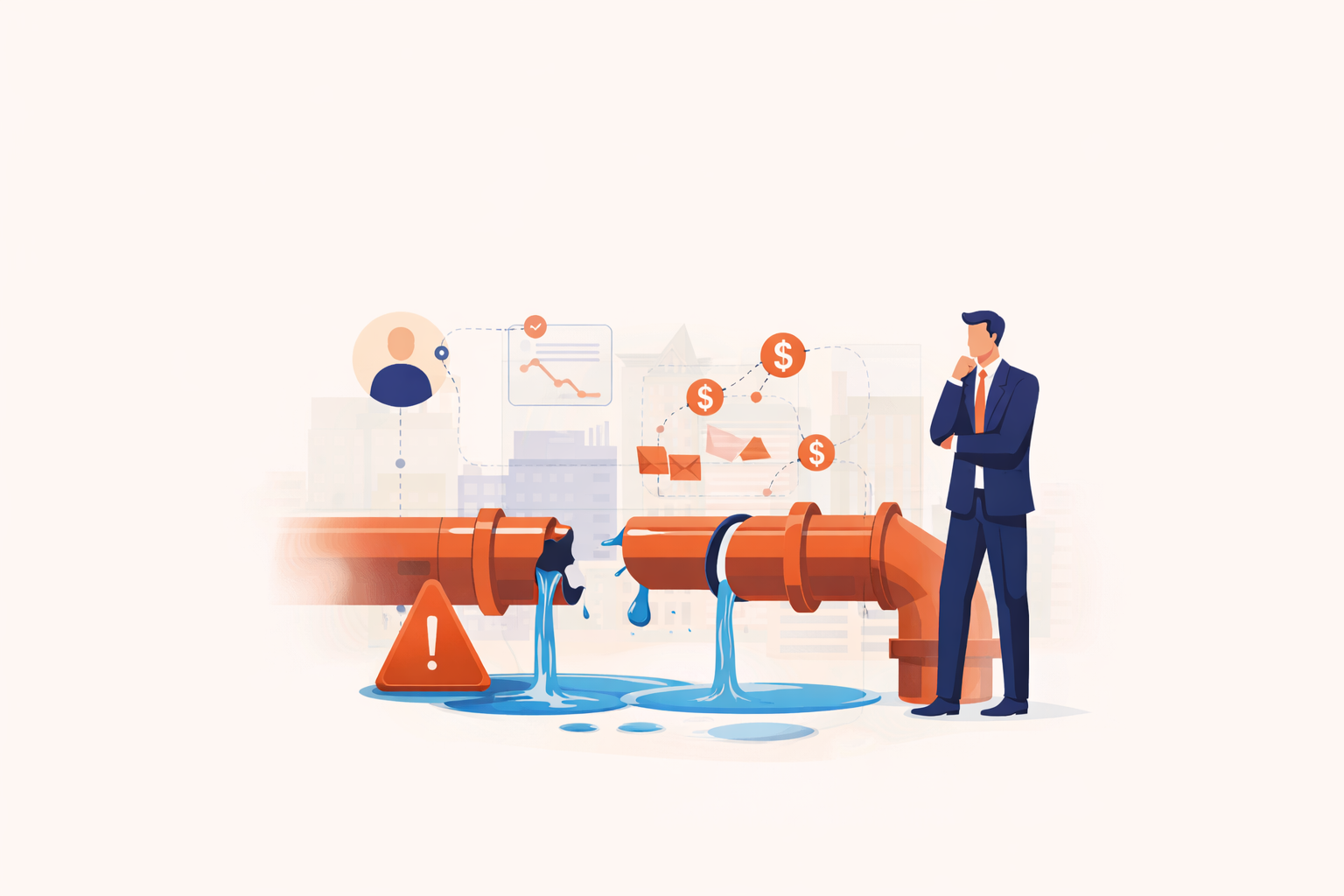
Growth without systems creates pressure. Growth with systems creates leverage.
Most businesses experience this distinction firsthand. Things are working, demand is growing, the team is busy, and then somewhere in the middle of what should be a good season, everything starts to feel harder than it should. Response times slip. Quality becomes inconsistent. People are working longer hours but producing less. The business is growing, but it doesn’t feel like it.
That’s not a demand problem. That’s a systems problem.
Why Growth Without Structure Breaks Things
Many businesses reach a point where progress slows, not because customers aren’t there, but because the business can’t handle more volume efficiently.
When a business is small, the absence of formal systems isn’t always obvious. Things get done through effort, memory, and the fact that everyone knows everyone. The founder handles the important decisions personally. The team figures things out as they go. It works, up to a point.
But as volume increases, the cracks appear. Manual processes become bottlenecks. Team members spend more time managing chaos than doing meaningful work. Results become inconsistent because outcomes depend on who’s available, who’s paying attention, or how much energy someone has on a given day.
The ceiling isn’t the market. It’s the infrastructure.
What Scaling Actually Means
Scaling is not about doing more work. It’s about building the capacity to produce better outcomes without a proportional increase in effort or cost.
That distinction matters. A lot of businesses try to scale by hiring more people, running more campaigns, or simply pushing the existing team harder. This can buy time, but it doesn’t solve the underlying problem. If the system is broken, adding more people to it just means more people dealing with a broken system.
True scaling requires stepping back from the day-to-day and asking a different question: how does this work when I’m not personally involved? How does this hold up under twice the volume? What breaks first, and why?
The answers reveal where the real work needs to happen.
The Three Areas That Must Be Systematised
There are three parts of most businesses where the absence of systems causes the most damage.
The first is lead generation. If your pipeline depends on relationships being personally managed, campaigns being manually run, or referrals coming in when they happen to, you don’t have a lead generation system. You have a lead generation habit. Habits are inconsistent by nature. Systems produce repeatable results regardless of who’s managing them on any given week.
The second is the sales process. When sales performance lives inside the heads and habits of individual team members, results vary wildly. A structured sales process, with defined stages, clear handoffs, and consistent messaging, takes some of that variability out of the equation. It also makes onboarding faster and performance easier to diagnose and improve.
The third is operations. This is where scaling problems tend to become visible most quickly. As volume increases, any manual step in the operational chain becomes a constraint. Fulfillment slows. Communication breaks down. Errors increase. Customers notice. Building operational systems before they’re urgently needed is one of the most overlooked investments in growth.
Automation Is a Tool, Not a Strategy
Automation plays an important role in scaling, but it’s worth being precise about what it can and can’t do.
Automation works when it’s applied to a process that already works well. If a process is broken, automating it just makes the mistakes happen faster and at greater volume. Before you automate anything, you need to understand it clearly enough to document it, and to know what a good outcome looks like.
When that groundwork is in place, automation becomes genuinely powerful. Routine tasks, follow-ups, reporting, notifications, scheduling, these don’t need human attention every time. When they’re automated, the team gets that time back for work that actually requires judgment: strategy, relationships, problem-solving, creative thinking.
The goal isn’t to remove people from the business. It’s to remove people from tasks that don’t require them.
Structure Before Tools
One of the most common mistakes businesses make when trying to scale is reaching for tools before establishing structure.
A CRM doesn’t fix a broken sales process. A project management platform doesn’t fix unclear team responsibilities. A marketing automation tool doesn’t fix vague positioning. These tools are designed to support systems that already function. When there’s no underlying structure, the tools just add complexity and a monthly subscription cost.
The sequence matters. First, define the process. Map out what should happen, in what order, and who’s responsible for each step. Then document it clearly enough that someone new could follow it. Then, and only then, look for tools that can support or accelerate what you’ve built.
Structure first. Tools second.
The Goal Is Simplicity, Not Sophistication
There’s a temptation when building systems to make them comprehensive, to capture every edge case, build in every contingency, and create something impressive. That instinct usually produces the opposite of what scaling requires.
Complexity is fragile. Simple systems are resilient. They’re easier to train people on, easier to audit when something goes wrong, and easier to improve over time. Every unnecessary step in a process is a potential point of failure.
The goal is not the most sophisticated system. It’s the simplest system that consistently produces the result you need.
What a Scaled Business Actually Looks Like
When your systems are aligned, the experience of running the business changes.
Decisions get made faster because the criteria are clear. New team members get up to speed more quickly because the processes are documented. Results become more predictable because they’re no longer dependent on individual effort or circumstances. And growth, when it comes, doesn’t break things. It just runs through a system that was built to handle it.
That’s the difference between growth that creates pressure and growth that creates leverage.
It doesn’t happen by accident, and it doesn’t happen all at once. But every system you build, every process you document, every manual task you remove from someone’s plate, is a step toward a business that scales sustainably.
That’s what makes it worth building properly from the start.